Strap in, gang. It’s going to be a long one. ❤
Women Shining
Early in my comedy career, I noticed that female comedians were largely relegated to “girl” shows. There were a handful of about five or six women (myself included) whom I would regularly see on stages throughout the scene. Outside of that handful, however, I mostly saw women on lineups for specialty shows—ones specifically highlighting women and queer voices. These spaces are vital. Those shows were full, fun, well-run, and I had no notes.
That said, I wondered how we could get more women onto more “mainstream” stages. I wanted the general public to see just how funny SO many women are. I wanted women performing more consistently, in front of bigger and more diverse audiences. There was a club I had been working with that often partnered with comics to produce all kinds of mainstream shows. I approached the producer about putting on an all-girl show and, to my delight, he was interested! He released a poster with a provocative name for the show and the words “Coming Soon!”
A female producer reached out to me to express how upset she was by the announcement and the show’s name. Among other things, she said:
“[…] I feel like him posting this […] is a mockery. Like he can easily create an all women show just as well as any of us even after all the really hard work we’ve put into create spaces where women shine.”
This, of course, could not have been further from the truth. I was so confused. I tried to explain my intentions to her and asked that she keep an open mind. She agreed, and I went back to the producer to discuss some of the concerns that had been raised. He was open to the conversation but equally confused. How, or why, would creating more space for women be perceived as an attack on spaces that already existed for women? After several hours of discussion, he reached out the following day to let me know he was pulling the plug. He said:
“My intention was never in bad faith. It was to highlight women in the community and get them audiences that typically do not attend their shows […] I’ve decided to postpone the show for now as the community – for all the reasons shared last night – is not ready for my involvement. For now, I believe this is the best decision for all parties.”
I cried.
By the way, the female producer never followed up with me about the show. Never asked for the date. Never asked how I was doing. Never asked if she could get tickets. Never asked how she could support. When I think back to that experience, I wonder whether she was genuinely concerned about “women shining” in general, or whether she only wanted women to shine so long as she approved of the light.
Women Sticking Together
Years passed and FINALLY! I was able to co-produce a women’s show. Same producer, but (perhaps!) the scene was now ready for his involvement. It remains one of my favourite experiences in comedy thus far. Making promo videos with the comics, sharing the stage with women I loved, performing for an audience of 60+ people! It was wonderful. The next day, I made a post thanking all the women involved. I also thanked the club (and, by extension, its male producer) for creating spaces that highlight women. Shortly after, a few people sent me an Instagram story asking, “Hey, is this about you?”
It was a video of another female producer. It opened with her rolling around in bed, declaring:
“What we’re not going to do under the guise of female empowerment is thank the wrong people. […] Don’t thank the wrong people […] that’s propaganda. […] Ladies, let’s get it together. Let’s STICK together.”
She chose to address this publicly. I did not. I didn’t owe her anything, but I wanted to understand what was happening. So I reached out privately and asked her directly whether the video was about me thanking the club. She said it wasn’t “exclusively” about me. Perhaps she genuinely believed the producer I worked with was causing harm because of her own experiences and was concerned about me. I wanted to believe that, but her actions made it difficult. If she had a problem with him, she could have gone after him OR genuinely shared her concerns with me (in private).
What she didn’t need to do was publicly come after me under the guise of women “sticking together.” She apologized that she “may have missed the mark,” and that conversation ended about as well as it could have. I didn’t particularly care for her, and I certainly didn’t feel that she cared about me. But that was neither here nor there.
You can respect people you don’t care about. I think you can even respect people you don’t like. You probably should, actually. When I think back to that experience, I wonder whether she was genuinely concerned that my post was spreading “propaganda,” or whether she was upset because it was countering some of hers.
Mistake
More years passed. Around this time last year, a TikTok began circulating from yet another female producer, criticizing the same club and producer I had worked with (are we seeing a pattern?) over their use of AI-generated videos. The criticism itself was valid. I think the use of AI (in some contexts) is lame. That said, I felt her video was much less “uplift the arts” and much more “moral grandstanding to kick off a smear campaign.” Once again, I reached out privately to understand why someone would choose to publicly blast someone rather than address their concerns directly. She didn’t owe me anything, but if I want information, I’ll usually go right to the source.
Mistake.
That private text exchange was followed by yet ANOTHER shady post from our previous Instagram propaganda queen, which ended with her not-so-subtly calling me out. Again. Then someone shared the post in a large public forum. Then the mean comments came rolling in. Then I stepped in to try to clear my name.
Another mistake.
Then our original female producer from years past chimed in about morality, AI, and how people should and should not run their businesses. Then ANOTHER woman came forward with her version of events about a separate negative experience she’d had. Then more accusations. More comments. More likes. More shares. More snide remarks. On and on and on, forever and ever, amen. This online world of mean girls, subtweeting, and cyberbullying was new to me.
When I look back at these experiences, I keep coming back to the same question: How did these women’s grievances with one male producer repeatedly end with me losing opportunities and becoming the target of public shaming?
I didn’t know that being associated with a man who was the subject of another woman’s ire automatically made you anti-woman. I think it may be a numbers game, though. If three women don’t like a man, and you don’t share the same grievances, you’re a cunt.
Male Apologist
Two of these producers are self-proclaimed “girl’s girls.” A girl’s girl gets to decide who is a girl’s girl and who isn’t. They hold that power. Girls who don’t fall in line are labelled “pick-me girls.” But these producers had a very special name picked out for me: Male Apologist.
One of them was particularly angry that I had been pointing out what I believed were lies and inconsistencies in the retelling of different events, so she posted yet another story about me. She called me “vile” and “sick” and ended with:
“Funny how the very people you call fools would’ve had your back if you needed it.”
Who would have had my back? The women who had consistently left me out to dry? Who had privately and publicly bashed me? And here’s what bothered me most: I wasn’t asking anyone to change their feelings toward this man. I wasn’t demanding that anyone work with him, defend him, or even excuse his behaviour. I was refusing to adopt their opinions as my own.
After being dragged through the wringer, I began to realize that, none of this was really about women shining or female empowerment or even AI. What started as separate grievances had become something much bigger, and I couldn’t shake the feeling that it all came down to one thing: power. Who had it. Who got to wield it. And how feminism could be used to keep it.
Whose Feminism?
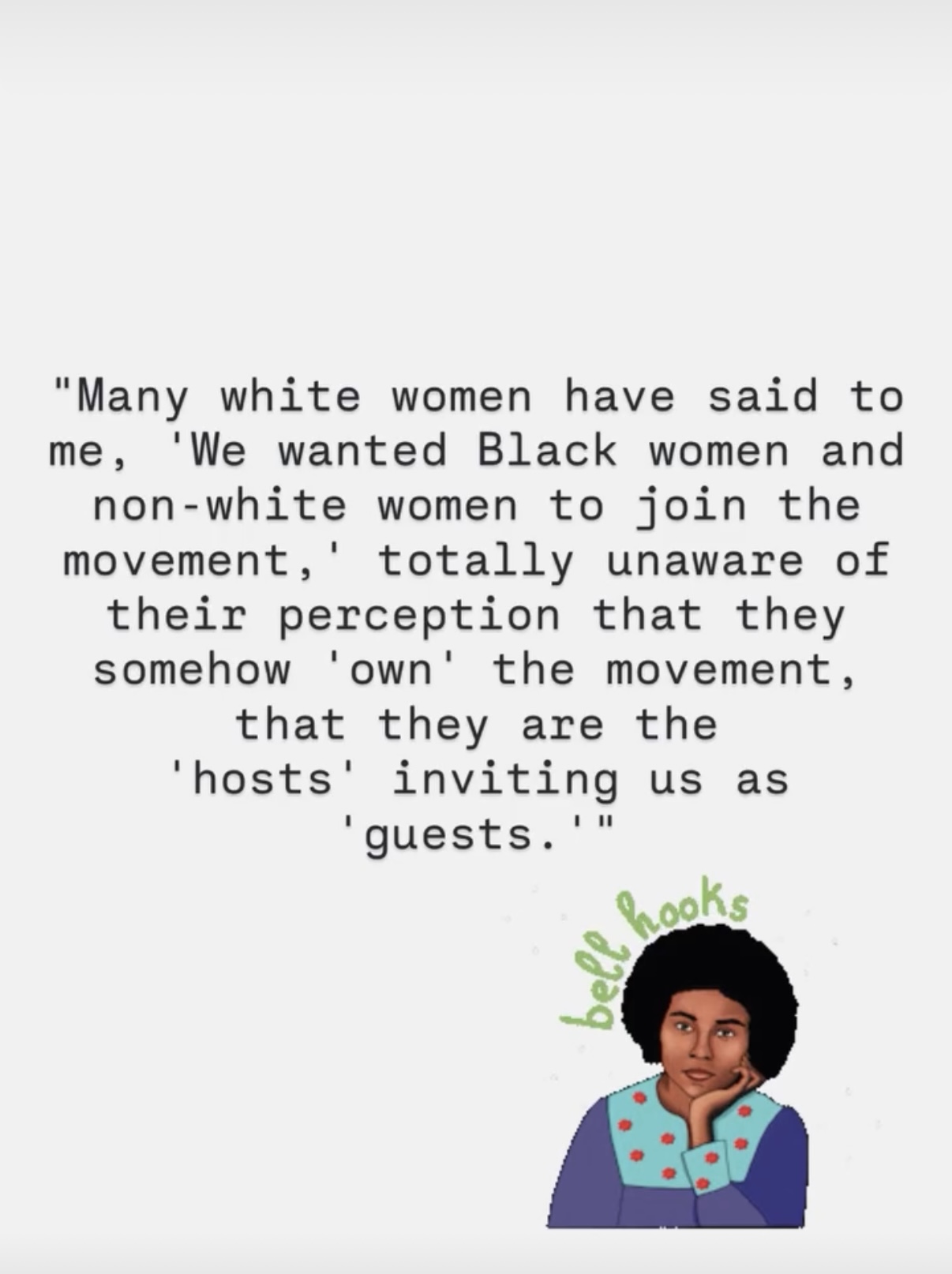
I recently went away for a week and read an incredible book called White Tears/Brown Scars: How White Feminism Betrays Women of Color. Please pick it up. It helped me make sense of what I’d been experiencing at the hands of these women—not all White, but all exercising what I understand to be White feminism.
White feminism isn’t simply feminism practised by white women. It’s a form of feminism that ignores how race, class, and other forms of inequality intersect, assuming all women experience life the way white women do. Like White Supremacy, it positions itself as the authority on truth. Women of colour do not have access to the same social power, credibility, or institutional protection that white women do. So how can white feminism decide what feminism looks like for us?
White feminism consolidates power and demands that all women bend the knee.
All three producers seemed to believe they had the moral high ground, and with it, the authority to control the narrative and wield their feminism at will. Whether it was a “fearless woman” hiding behind a keyboard to drag someone’s use of AI, a girl’s girl who got to decide what female empowerment really meant, or someone who seemed more concerned about who was creating spaces for women than about the fact that more spaces were being created at all. Different circumstances. Different women. Same question:
Who gets to decide what feminism looks like, and who gets punished for disagreeing?
Intersectionality
R.G. Callahan posted on Threads:
“We were told racism was about hatred. That’s why so many people missed that it was always about power.”
The male producer at the centre of these stories is a man of colour. In my five years in comedy, I’ve often felt that I was being indirectly asked to choose between my race and my gender. My feminism cannot come at the cost of my Brown identity. I was being asked to condemn someone many folks dislike because they disagreed with some of his decisions. I disagree with some of his decisions, too. He can be a real dickhead sometimes. Most people can be. But I also believe that much of the mistreatment I’ve witnessed toward him has been rooted in the double standards of racism.
He is portrayed and perceived as a shifty Brown man. Doing shifty Brown things. He’s the immigrant stealing your job and the reason why you can’t move up. Where some people engage in normal, friendly business competition, he’s cheap and corrupt. Probably committing some kind of fraud. These are the stereotypes I recognize in the way he’s treated. Stereotypes I am very familiar with as a Brown woman. What you cannot control or understand, you fear.
Racism and white supremacy don’t always look like the KKK anymore. If only it were that easy! They look more like double standards. Or demanding intimate details of one person’s business practices without ever having to divulge your own. Or undermining someone’s credibility while treating your own as unquestionable. Or insisting that your version of events is the only acceptable one.
Worst of all, they look like performative allyship.
Fuck Girl’s Girls
I need you to know that I couldn’t give less of a fuck about being “a girl’s girl,” and neither should you. It is yet another way women can weaponize feminism to solidify power and demonize anyone who dares step out of line. My sweet pal Olivia introduced me to a phrase that I love:
“We don’t support all women. But we protect all women.”
A true ally will protect you even if they don’t like you. Be wary of anybody who has all the right words and all the wrong actions (or inaction). Allyship doesn’t mean freedom from legitimate criticism, but it should mean refusing to dehumanize someone. I have not written anything on this blog in almost a year because I was so afraid of the retaliation I might face online from people who can’t even look me in the eye in a public place. They called me:
Male apologist. Christian gaslighter. Angry. Delusional. Insane. Unhinged. Aggressive. Unabashed racist. Piece of shit. Cruel. Vile. Sick. Gross. No integrity. Pathetic. Maggot. Scumbag. Insecure. Brat. Jealous. Petty. Idiot. And worse.
And those are just some of the documented ones 😉
Can you guess who was leading the charge against me? Who didn’t try to put an end to any of it? Who chose silence and performative allyship? Who decided I wasn’t “girl’s girl” enough to deserve protection? Whose feminism decided my humanity could be denied?
I spent the last year believing the only choices I had were to retreat or retaliate. I chose retreat. For a long time. If you’re a WOC and have chosen to retreat because it’s all too much, I see you. If you’ve been burned by other WOCs or folks you thought were allies, I’m sorry.
We cannot let people who value power over people determine the terms and conditions of our dignity.
As Cole Arthur Riley writes:
“Be careful what company you allow to shape your conscience or orient you on the journey. Not all are adequate guides.”
We don’t have to retreat.
We don’t have to retaliate.
We just have to re-group. ❤

